

Note: My readers may have noticed that I’ve not been writing as frequently. This fall, I started my master’s degree in Christian Apologetics at Biola University, reading about 600 pages a week. I hope this immersion will help my writing as I try to understand today’s culture, politics, innovation, and the news through the lens of the Bible. One of my classes is The Philosophy of Nietzsche. It’s been fascinating to learn about him as his philosophical ambition in life was to challenge inherited moral values, especially the Christian ethos that has been the driving moral force across centuries. Many scholars and writers have traced the roots of postmodern and woke ideologies to the void Nietzsche helped create by pushing out God. And many have argued that Nietzsche’s will to power has been forever distorted and leveraged to defend dominance-at-all-cost thinking. With this in mind, I think my readers will enjoy learning about Nietzsche through some of the short essays required for my class. As they’re all graded, I can start publishing them here. Enjoy!
From The Birth of Tragedy. What is Aesthetic Theodicy?
Theodicy is a branch of philosophy that tries to defend God’s goodness in a cruel and evil world. Aesthetic Theodicy does not give a moral justification, rather art becomes the means through which an existence containing suffering is justified. Art forms, such as plays, paintings, music are not just imitations of reality but “metaphysical supplements,” according to Nietzsche (p. 85, The Nietzsche Reader), that turn our experiences of pain and suffering into something not just tolerable, but welcomed.
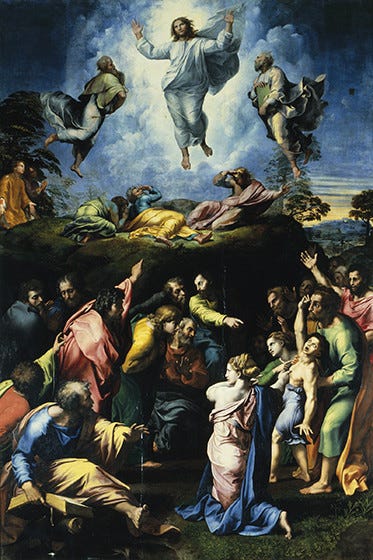
For instance, in Raphael’s Transfiguration, the painting depicts two different worlds: a possessed boy, reflecting “eternal original suffering” (p. 52, The Nietzsche Reader) juxtaposed with a heavenly “new vision-like world of appearance.” The painting places suffering and beauty within a single image in order for the ugly truth of existence to remain exposed as it becomes endurable by the artistic majesty and radiance of the painting. Nietzsche praised Raphael’s painting as “the highest symbolism of art” that conveyed the reciprocal necessity of both the Apollonian world of beauty and the Dionysian reality of suffering.
In The Birth of Tragedy, Apollo is the embodiment of beauty, order and individuation while Dionysus represents the substratum of collective suffering, chaos, and destruction. For Nietzsche, suffering is inherent in man’s existence. If he cannot lean on a redeeming God, he must find ways to confront and deal with suffering. Aesthetic Theodicy does so through the combination of Apollo and Dionysus.
Socrates provided a competing response to the problem of suffering: to understand it is to ultimately minimize or even eliminate it. To Nietzsche, the Greeks understood human nature far better than Socrates, who ruined Greek drama and tragedy with the emphasis on rationality and reason. For instance, under Socrates’ influence, Euripides’ plays spelled out the plot explicitly, reducing the element of surprise that could trigger an emotional response. In other words, the audience could intellectually understand a character’s pain, but didn’t necessarily feel the collective suffering of man like they did when they experienced a Dionysian chorus or music. It’s like having a joke explained to you. You get why it’s funny, but you miss the moment of guttural laughter.
Nietzsche admitted that aesthetic theodicy contains an illusion because art changes our relationship to suffering, but doesn’t prove it is morally justified. But at least it was complete. Socrates’ approach to mastering and minimizing suffering would reach a dead end because reason has its limits.
Image source: The Christian Century